
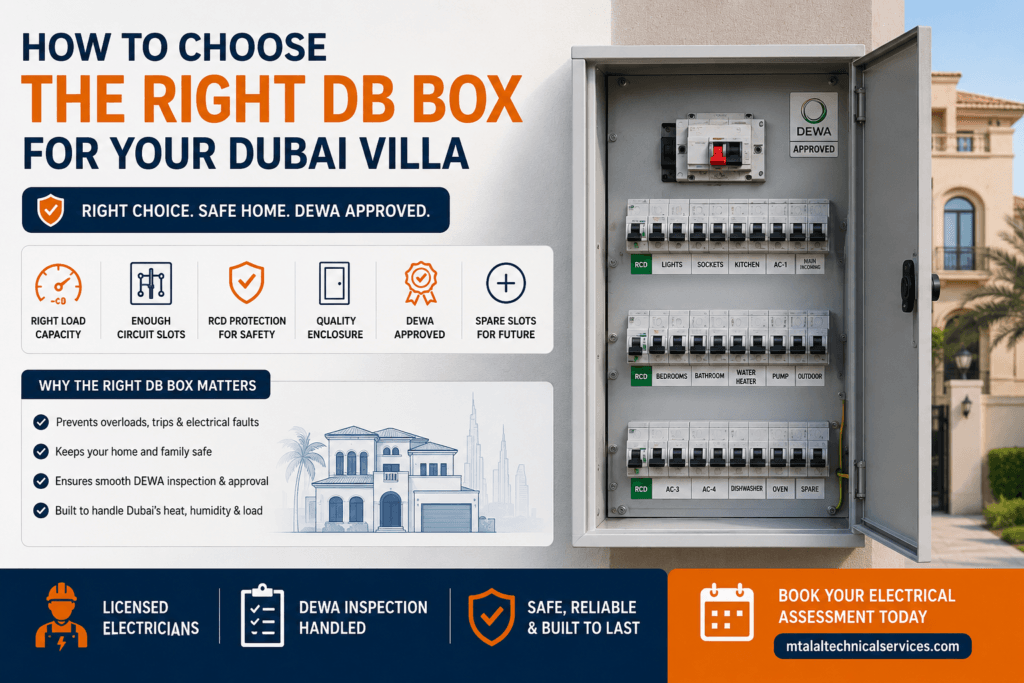
Most villa owners in Dubai never think about their DB box until something goes wrong. A breaker keeps tripping. The lights flicker. An electrician opens the panel and tells you the board is too old, too small, or was never set up correctly.
By that point, you are already under pressure. Maybe mid-renovation. Maybe days before a DEWA inspection.
The right distribution board saves you from expensive problems that show up months or even years later.
This guide breaks it all down simply. No confusing technical terms. Just the things you actually need to know before buying or upgrading a DB box for your Dubai villa.
At a glance: what to check and why
| What to check | Why it matters | Risk if ignored |
| Amperage rating | Must match your villa’s total load | High, overloads fire risk |
| Number of ways (slots) | One slot needed per circuit | Medium , no room to expand |
| RCD protection | Required for wet areas by code | High, DEWA rejection |
| Enclosure material | Must handle Dubai heat and dust | Medium, corrosion, early failure |
| DEWA-approved brand | Only approved brands pass inspection | High, failed inspection |
| Spare slots for future | Vilthe las grow over time | Low now, costly later |
What Is a DB Box and What Does It Actually Do?
A DB box, or distribution board, is the electrical panel that receives power coming into your villa and splits it across all the circuits in your home. Every room, every appliance group, and every major system, like your AC or water heater, runs on its own separate circuit.
Inside the board, each circuit has its own breaker. These breakers do one job: they trip and cut power when something goes wrong, before a fault can damage your appliances or, more seriously, start a fire.
When everything is matched correctly, your DB box just sits there quietly doing its job. When it is the wrong size or poorly installed, you end up with recurring electrical problems that no one can seem to fully fix.
The Key Things to Get Right When Choosing a DB Box
There are six things that matter most. Each one directly affects how safely and reliably your villa’s electrical system will run.
1. Amperage Rating , Match It to Your Load
The amperage rating tells you how much electrical current the board can handle at once. A typical Dubai villa has a lot running at the same time. Think about everything you use daily:
- Multiple split AC units running during summer
- A central water heater
- Full kitchen appliances, including oven, dishwasher, refrigerator
- Outdoor lighting and sometimes a pool pump
- Home office or entertainment setups
If the board’s amperage rating is too low for all of that, it will trip under normal everyday use. Not because of a fault, but simply because it cannot handle the load. Most medium to large Dubai villas need a main board rated between 100 and 200 amps. A licensed electrician in Dubai can calculate your exact needs before you buy anything.
2. Number of Ways, Leave Room to Grow
The number of ways refers to how many circuit slots the board has. You need one slot per circuit. The mistake most people make is buying a board with just enough slots for today, leaving no room for the future.
Dubai villas change over time. A new AC unit here, an outdoor kitchen there, maybe an EV charger eventually. If your board has no spare slots, you will need a full replacement sooner than expected. Always choose a board with at least four to six extra slots beyond what you currently need.
3. RCD Protection, Non-Negotiable for Wet Areas
An RCD, or residual current device, is a safety switch that cuts power in milliseconds if it detects any leakage current. This is what protects someone from electric shock in a bathroom, kitchen, or outdoor area where water is nearby.
RCD protection is required by Dubai electrical code for all wet area circuits. Skipping it means two things:
- A genuine risk of electrocution in your home
- An automatic fail on your DEWA inspection
Some boards come with RCDs built in per circuit. Others use a combined RCD module. Either way works fine, as long as the protection is there.
4. Enclosure Quality , Built for Dubai’s Climate
Dubai’s heat, humidity, and dust are tough on electrical components. A cheap enclosure will crack, warp, or allow moisture to get in over time. That leads to corrosion inside the panel, which is both a reliability problem and a safety problem.
When choosing a board, look for:
- A robust metal or high-grade polycarbonate shell
- A good IP rating for dust and moisture resistance
- Internal components from a manufacturer with a strong track record
This is genuinely not the place to cut costs. The enclosure is what keeps a live electrical panel safe to be near every single day.
5. DEWA-Approved Brand , This One Is Not Optional
DEWA has a list of approved brands and components that must be used in any Dubai electrical installation. If your board is not on that list, it will not pass the official inspection. Full stop.
A good electrician in Dubai already knows which brands are approved and will only source those. If someone is offering you a noticeably cheap board without mentioning DEWA approval, that is a red flag worth paying attention to.
6. Spare Slots for Future Circuits
This is a small decision that has a surprisingly big impact later. A board with four to six extra slots costs almost nothing extra at purchase. Replacing the entire board five years later because you ran out of space costs significantly more.
| IMPORTANT: DEWA APPROVAL IS NOT OPTIONAL Every distribution board installed in Dubai must meet DEWA’s technical standards. An unapproved board means a failed inspection and a mandatory replacement, at your own cost. If you are purchasing a board yourself, verify the brand and model are on DEWA’s approved list before you buy. Any reputable electrician in Dubai will handle this automatically. |
Single-Phase or Three-Phase , Which One Does Your Villa Need?
Most standard Dubai villas run on a single-phase electrical supply. This is perfectly sufficient for typical household loads and is the most common setup across residential properties.
A three-phase supply is needed for larger villas with:
- Heavy-duty central AC systems rather than individual split units
- Lifts or elevators inside the villa
- Industrial-grade appliances or workshop equipment
- Very large outdoor pool systems or commercial-sized setups
If you are unsure which applies to you, check your DEWA account online or ask a licensed electrician to assess the incoming supply. Buying the wrong type of board is one of those errors that cannot be patched later. It requires a full replacement.
| NOT SURE WHAT YOUR VILLA NEEDS? Our team does a full load assessment first, then recommends the right board for your specific property. No guesswork, no surprises. Book an Electrical Assessment at mtalaltechnicalservices. |
Signs Your Current DB Box Needs to Be Replaced
If you already have a board installed and are wondering whether it is still good, here are the warning signs that tell you it is time for an electrical panel upgrade in Dubai.
- Breakers trip regularly even under normal everyday use
- You hear a buzzing or crackling sound from the panel
- There are burn marks or discolouration around the board or nearby outlets
- You can smell something burning near the panel area
- The board has no RCD protection on kitchen or bathroom circuits
- The board is over 15 years old and has never been professionally inspected
- You have added new AC units, a new room, or major appliances since the board was installed
- You notice different brands of MCBs mixed inside , a sign of ad-hoc repairs over the years
If just one of these applies, it is worth getting someone to take a look. If several apply, it is genuinely urgent.
| FROM OUR TEAM A lot of the villas we visit in older Dubai communities still have the original boards from when the property was first built, sometimes 15 or even 20 years ago, and they have never once been checked. Meanwhile, the electrical load in those homes has roughly doubled. New AC units, smart home systems, home offices. The board was never designed for that. An electrical panel upgrade in Dubai for these properties is not about modernising, it is a genuine safety issue. |
How to Choose the Right Electrician for DB Box Installation
Even the best distribution board in Dubai can become a hazard if it is installed badly. Incorrect earthing, loose connections, or wrong circuit sizing will cause problems no matter how good the hardware is.
When you are hiring for a DB installation in Dubai, here is what to check:
- The contractor is licensed by Dubai Municipality
- They are familiar with DEWA’s approval and inspection process
- They will handle the DEWA inspection, not just the physical fitting
- They source only DEWA-approved brands and components
- They provide a clear quote before any work starts
Be cautious of contractors offering very low prices. The savings usually comes from using non-approved brands or skipping the inspection. Either way, you end up paying more to fix it later.
| Electrical, AC, and plumbing work at the same time? M Talal coordinates all trades in a single visit, so your renovation runs smoothly and nothing gets missed between contractors. |
Frequently Asked Questions
What size DB box do I need for a typical Dubai villa?
Most medium-sized Dubai villas need a board rated between 100 and 200 amps, with 20 to 40 circuit slots depending on the number of AC units, rooms, and appliances. The accurate way to confirm this is a load calculation done by a licensed electrician before you purchase anything.
Does a DB box in Dubai have to be DEWA-approved?
Yes, absolutely. DEWA specifies which brands and components are approved for use in Dubai properties. If your board does not meet those standards, it will fail the official inspection and you will need to replace it, at your own cost.
How long does a DB installation in Dubai usually take?
The physical installation for a standard villa replacement typically takes four to six hours. After that, the DEWA inspection and approval is handled separately and usually takes a few business days from the application date.
Can I just replace the DB box myself?
No. DB box installation in Dubai must be done by a licensed electrical contractor. Unlicensed electrical work fails DEWA inspection, voids your building insurance, and creates real safety risks for everyone in the property.
How often should a distribution board in Dubai be checked?
At minimum, every three to five years. Or immediately after any significant change to your electrical load, such as adding new AC units, a home office, or a new room. Boards in older Dubai properties that have never been inspected should be assessed as soon as possible.
Final Thoughts
Choosing the right DB box in Dubai really comes down to five things: correct amperage, enough circuit slots, proper RCD protection, a quality enclosure, and DEWA-approved components. Get those right and your board will do its job quietly for years without any drama.
The problems usually start when people buy based on price alone, or skip the professional assessment entirely. Both are easy mistakes to avoid. If you are planning an installation or think your current board is overdue for a review, our team is happy to come out, assess your villa honestly, and give you a clear recommendation before any work begins.