
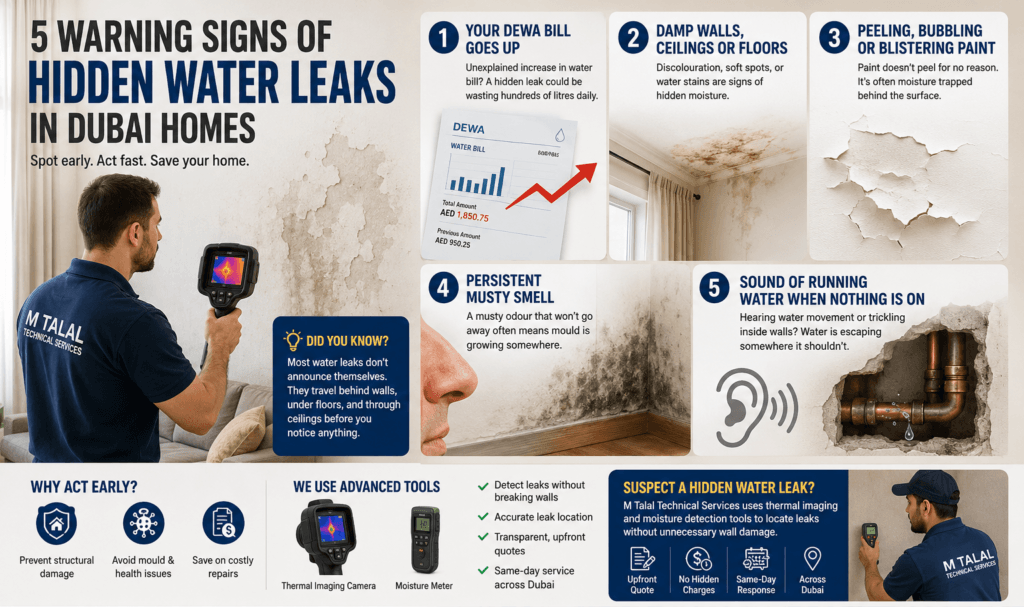
Most water leaks do not announce themselves. There is no burst pipe, no flood, no obvious dripping. Instead, the water quietly travels behind your walls, under your floors, and through your ceiling before you notice anything at all.
By the time a visible stain appears, the damage is usually already weeks or even months old.
In Dubai specifically, hidden leaks are more common than many homeowners realise. The combination of high-pressure plumbing systems, extreme heat that causes pipes to expand and contract constantly, and buildings that are now ten to twenty years old creates ideal conditions for slow, concealed leaks. Left undetected, they lead to mould, structural damage, and repair bills that multiply fast.
Knowing what to look for early is one of the most valuable things you can do as a Dubai homeowner.
Here are the five warning signs that should put you on alert.
Sign 1: Your DEWA Bill Goes Up With No Obvious Reason
This is often the first sign that something is wrong, and most people dismiss it. They assume the extra cost is from longer showers in summer, a guest staying over, or the dishwasher running more often.
But if your DEWA water bill climbs noticeably without any real change in your household routine, a hidden water leak in Dubai is a serious possibility. Even a slow drip inside a wall can waste hundreds of litres per day, depending on the pipe pressure.
- A simple check: turn off every tap and water-using appliance in your home, then watch your water meter for 15 to 30 minutes. If the meter is still moving, water is going somewhere it should not be.
Sign 2: Walls, Ceilings, or Floors That Feel or Look Damp
You might notice a patch on the wall that looks slightly darker than the surrounding area. Or a spot on your ceiling with a faint yellow or brown ring. Or floor tiles that feel slightly soft underfoot. These are not cosmetic issues. There are signs that water is present where it should not be.
In Dubai apartments and villas, wall seepage often comes from a leaking pipe behind the wall, a failed waterproofing layer in the bathroom above, or a condensation issue tied to the building’s drainage system. Ceiling stains in particular tend to indicate a leak from the unit or bathroom directly above yours.
The important thing to understand is that by the time moisture becomes visible on the surface, the area behind it is already saturated. What looks like a small stain often points to a much larger soaked zone behind the plaster or tiles.
| QUICK CHECK Try This Before You Call: Press your finger gently against a suspicious wall patch. If it feels cooler than the surrounding wall or leaves a faint damp trace on your fingertip, there is moisture trapped behind it. That warrants a proper moisture detection inspection. |
Sign 3: Paint or Wallpaper That Is Peeling, Bubbling, or Blistering
Fresh paint does not peel without a reason. If you see bubbling or blistering on painted walls, or wallpaper that has started lifting at the edges, trapped moisture is almost always behind it.
This type of water damage in Dubai homes often goes unnoticed for weeks because the surface still looks mostly intact. People assume the paint is old or the surface was poorly prepared. In many cases though, a pipe joint behind that wall has been slowly weeping for months.
Check the areas around bathrooms, kitchens, and any external-facing walls first. These are the highest-risk zones in most Dubai apartments and villas.
Sign 4: A Persistent Musty Smell That Will Not Go Away
If there is a lingering smell in a room that does not improve no matter how much you clean or ventilate, that is a serious sign. Musty odours in enclosed spaces almost always mean mould or mildew is growing somewhere, and mould only grows where there is sustained moisture.
In Dubai, where buildings are tightly sealed to keep the AC working efficiently, a hidden water leak can create exactly the kind of trapped, humid environment that mould needs. You might not see any mould on the surface, but it can be growing actively behind tiles, inside wall cavities, or under flooring.
Beyond the structural damage it causes, mould has real health implications, particularly for anyone with respiratory issues or allergies.
| IMPORTANT NOTE: Two Signs Together Mean Act Now If you are dealing with a persistent musty smell alongside a damp wall or peeling paint, do not wait. These signs together strongly suggest an active hidden water leak in Dubai that is already causing secondary damage. The longer it continues, the more it costs to fix. |
Sign 5: The Sound of Running Water When Nothing Is On
This one catches people off guard. You are sitting quietly in a room, all the taps are off, no appliances are running, and you can faintly hear the sound of water moving or trickling somewhere inside the wall.
That sound has a source. It is not the pipes settling or normal building noise. Water is moving through a crack or gap in your plumbing, and in a pressurised system like the kind used in most Dubai buildings, that water is going somewhere it should not be.
If you hear this, note the room and wall where the sound seems loudest. That information is useful when a technician comes to inspect.
Why Dubai Homes Are Especially Vulnerable
It is worth understanding why hidden leaks are so common here. Dubai’s climate puts plumbing systems under constant stress. Pipes expand in the heat and contract when the AC cools the building overnight. Over the years, that repeated movement causes pipe joints and sealants to weaken and eventually fail.
Many buildings constructed during Dubai’s major growth period in the 2000s are now at the age where plumbing wear becomes a real issue. Add in the coastal humidity in areas near the Creek or Marina, which accelerates corrosion inside walls, and the risk compounds further.
What to Do If You Spot Any of These Signs
- If you notice one sign only, don’t panic—just monitor it closely.
- Do the water meter test (as explained earlier) to check if there is a hidden leak.
- If you notice two or more signs together, it strongly indicates an active leak. In this case, waiting can make the damage worse.
Why You Should Act Quickly
- Early action helps prevent:
- Wall and floor damage
- Mould and damp issues
- Higher repair costs later
How Professionals Can Help
- Plumbing services in Dubai now use modern, non-invasive tools, such as:
- Thermal imaging cameras
- Moisture meters
- These tools help:
- Detect leaks without breaking tiles or walls
- Save time and reduce repair costs
What You Get in a Proper Inspection
- A clear diagnosis of:
- Exact leak location
- Root cause of the problem
- Required repair solution
- Before any work starts, you receive:
- A transparent, upfront quote
- No hidden or surprise charges
Extra Check (If Needed)
- If moisture is found near:
- AC drainage lines
- Ducting or cooling system
- The team can also:
- Perform a complete AC system check in the same visit
- Ensure the cooling system is not contributing to the issue
| Suspect a hidden water leak in your Dubai home? The plumbing team at M Talal Technical Services uses thermal imaging and moisture detection tools to locate leaks without unnecessary wall damage. Upfront quote, same-day response across Dubai. |
Frequently Asked Questions
Q: How do I know if I have a hidden water leak in Dubai?
The most reliable early indicators are an unexplained rise in your DEWA bill, damp or discoloured patches on walls or ceilings, peeling paint, a musty smell in closed rooms, and the sound of water running when nothing is switched on.
Q: Can a hidden water leak cause mould in my Dubai apartment?
Yes. Mould needs sustained moisture and a warm, enclosed environment. A slow, hidden leak inside a wall creates exactly those conditions. In tightly sealed Dubai apartments, mould can develop behind walls within weeks of a leak starting.
Q: Is wall seepage in Dubai always caused by a plumbing leak?
Not always. Wall seepage in Dubai can also result from failed waterproofing on a roof or terrace, condensation in poorly insulated walls, or water entering from an exterior crack. A professional inspection determines the actual source.
Q: How is moisture detection done without breaking walls?
Professional moisture detection uses thermal imaging cameras that detect temperature differences caused by damp areas, acoustic tools that listen for water movement inside pipes, and moisture meters that measure water content in building materials. These methods locate leaks precisely without unnecessary demolition.
Q: How quickly should I act if I suspect a water leak?
As quickly as you can. Water damage in Dubai compounds quickly because of the high ambient temperatures that accelerate mould growth and material deterioration. What starts as a small leak can cause tile removal, plaster replacement, and structural repair if left for several weeks.
Do Not Wait for the Stain to Grow
Hidden water leaks rarely get better on their own. Once a pipe joint or waterproofing layer starts failing, it continues to worsen under pressure. The damage builds silently while you carry on with your day.
If you have spotted any of the five signs described above, particularly wall seepage or a rising DEWA bill with no explanation, it is worth getting eyes on it professionally. Early detection through proper water leakage repair in Dubai is almost always significantly cheaper than repairing the damage that follows from waiting.
Your home deserves to stay dry. That starts with knowing what to look for.